
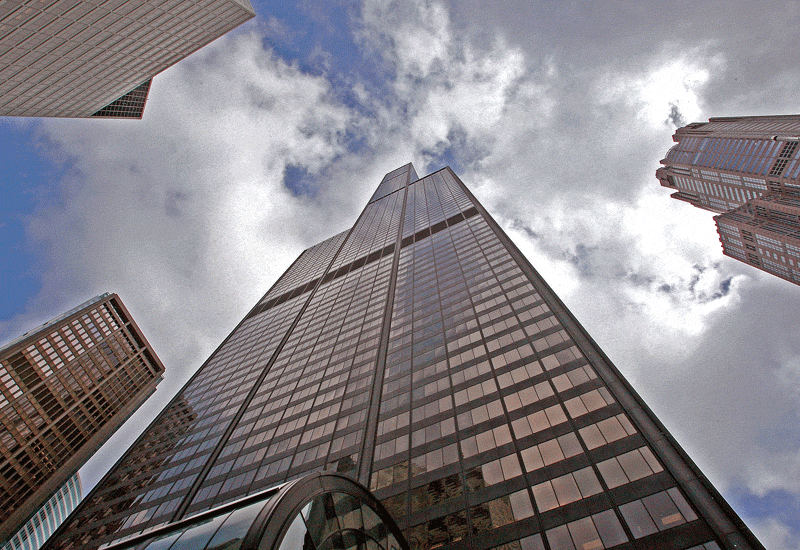
Mega-tall structures stand as iconic symbols of progress and modernity, dominating city skylines and fostering healthy competition between nations in the race to construct the world’s tallest building. While these structural marvels evoke awe and admiration, the pursuit for constructing them introduces a dynamic interplay of possibilities and challenges. Steel structures emerge as a pivotal force, driven by their remarkable strength-to-weight ratio, ductility, and adaptability. These attributes have not only revolutionized construction, pushing the boundaries of design and height, but have also fueled the aspirations of architects and engineers to reach new heights. However, it becomes imperative to acknowledge and navigate the limitations accompanying the use of steel in mega-tall structures. This article exclusively delves into the challenges posed by steel structures and examines how technology addresses these constraints in the ambitious pursuit of vertical ascension.
Steel Structures in High-Rise and Mega-Tall Building Design
Navigating Forces and Dynamics
As architects and engineers embark on the construction of mega-tall buildings, the foundational equation F=ma, derived from Newton’s second law, holds significant implications. Understanding the impact of wind on these structures is crucial for comprehending how forces are generated. This law stipulates that for a given force acting upon an object, the resulting acceleration is directly proportional to the mass of that object. Such principles are fundamental in structural dynamics, especially concerning mega-tall buildings. However, the lightweight nature of steel poses a notable limitation in this context. Steel’s low mass leads to heightened accelerations within the structure when subjected to external forces, consequently resulting in increased oscillations and vibrations.
In the construction of mega-tall buildings, engineers grapple with the delicate balance between period limitation and acceleration control, both essential for ensuring structural stability, occupant comfort, and meeting performance targets. Acceleration control plays a pivotal role in achieving this objective. Structural steel presents significant challenges in this domain, primarily due to its low mass, leading to increased accelerations and oscillations within the structure, particularly in mega-tall buildings where forces are magnified due to their immense height. This limitation underscores why mega-tall buildings predominantly utilize concrete structures instead.

Addressing Challenges in Mega-Tall Constructions with Structural Steel
Despite the beneficial qualities of steel, there are inherent drawbacks that require careful consideration in constructing these towering buildings, in addition to the occupant discomfort due to the building’s response to external forces and lighter mass compared to RC structures, let’s delve into the other challenges posed by steel structures as we navigate the delicate balance between ambitious aspirations and practical limitations in constructing extremely tall buildings.
Vertical Logistics and Material Transportation
Building mega-tall buildings involves a complex dance of vertical logistics and material transportation. Unlike reinforced concrete structures, the transportation of materials and equipment vertically becomes a monumental challenge. Efficient and reliable vertical transportation systems, including high-capacity elevators, hoists, and cranes, must be carefully integrated into the construction plan. Coordinated scheduling of material deliveries, strategic storage solutions at different heights, and seamless coordination among construction teams are essential to optimize the flow of materials from the ground to the uppermost floors. Additionally, safety measures for material transportation at such heights must be rigorously enforced to prevent accidents and ensure the smooth progression of construction activities.
Welding Challenges
Welding in the construction of mega-tall steel structures presents unique challenges that demand precise execution and rigorous quality assurance. As the height of the building increases, access limitations pose challenges for welders working at elevated levels. Adverse weather conditions, such as high winds, can further complicate the welding process. Ensuring the quality of welds is c`ritical for the overall structural integrity of the building. Advanced welding techniques, such as ultrasonic testing and automated welding systems, are employed to achieve consistent and high-quality welds. Quality assurance programs are implemented to monitor the entire welding process, from material preparation to final inspections. Strict adherence to welding standards and continuous training programs for welders are essential components of a comprehensive approach to overcoming the welding challenges associated with constructing mega-tall steel structures.
Financial Landscape of Construction
Constructing tall buildings with steel structures often entails higher costs compared to using reinforced concrete. This is primarily due to the necessity of employing high-quality steel to meet the rigorous structural requirements, which significantly inflates material expenses. Furthermore, the intricate engineering involved in designing these structures, such as advanced modeling and the integration of damping systems, adds to both design and analysis costs. Fabrication processes demand precision, specialized techniques, and skilled labor, all of which contribute to increased expenses. Additionally, the complexity of construction logistics, specialized equipment requirements, and stringent safety measures further elevate operational costs. The transportation and handling of steel components, as well as site-specific challenges and adherence to rigorous building codes, also entail additional expenses. Ongoing maintenance of steel structures adds to the long-term financial investment. While steel offers undeniable advantages in terms of strength and flexibility, the decision to opt for mega-tall steel structures necessitates a careful consideration of these benefits in relation to the associated costs.
Fire Safety
Ensuring fire resistance is paramount to safeguarding the structures and its occupants. While steel structures offer notable advantages in terms of strength, flexibility, and speed of construction, their susceptibility to fire poses a significant challenge. Unlike concrete, steel can lose its strength and integrity when exposed to high temperatures, potentially leading to catastrophic structural failure. To address this concern, engineers implement rigorous fire protection measures such as fireproof coatings and intumescent paints to delay the onset of structural damage during a fire event. Additionally, advanced fire detection and suppression systems are integrated into the building design to enhance safety and mitigate the risk of fire-related incidents. Despite these efforts, achieving optimal fire resistance in steel structures remains a complex undertaking in the construction of mega-tall buildings, highlighting the need for continuous innovation and meticulous engineering solutions to ensure the safety and resilience of these architectural marvels.
The Role of Innovation in Mega-Tall Building Construction with Steel Structures
Damping systems
In mega-tall buildings, damping systems play a critical role in mitigating the dynamic effects of wind and seismic forces on steel structures. These structures are inherently susceptible to oscillations and vibrations due to their height and slender profiles. Damping systems, such as tuned mass dampers (TMDs) and viscous dampers, are strategically incorporated into the building design to counteract these effects and enhance structural stability.
Tuned mass dampers consist of a mass-spring system tuned to the building’s natural frequency, effectively reducing the amplitude of vibrations caused by external forces. These dampers operate by moving in the opposite direction to the building’s motion, thereby dissipating energy and minimizing oscillations. Viscous dampers, on the other hand, utilize fluid-filled cylinders to absorb and dissipate kinetic energy, damping out vibrations and reducing structural movement.
By effectively controlling oscillations and vibrations, these systems enhance the overall performance of steel structures, mitigating the risk of fatigue and structural failure. Through advanced engineering and innovative design solutions, damping systems continue to play a crucial role in the successful construction and operation of mega tall buildings around the world.
High-Strength Steel Alloys
Steel alloys play a crucial role in the construction of tall buildings despite their reduced mass, as they offer a balance between strength and weight that optimizes structural performance. While it is true that lighter steel alloys can contribute to increased acceleration in mega tall buildings, their enhanced strength-to-weight ratio allows for the fabrication of structural elements that can withstand the forces acting upon them with greater efficiency. Steel alloys possess higher strength compared to conventional steel, enabling the design of lighter yet robust components that minimize material consumption while maintaining structural integrity. Additionally, the reduced mass of steel alloys can be offset by implementing stronger damping systems, mentioned previously, to mitigate acceleration and ensure occupant comfort. Overall, the use of steel alloys in mega tall building construction offers a versatile and efficient solution that maximizes structural strength while addressing the challenges associated with reduced mass

At PEER, we strongly believe in the power of technology and the ingenuity of scientists to find solutions for all the challenges posed nowadays specially for tall and mega-tall structures. While steel has historically served as a highly adopted system for major structures, we recognize the evolving demands of high rise buildings and the need for a broader exploration of alternative approaches. As the limits of conventional steel construction are tested by the ambitious heights of modern architectural endeavors, we remain confident in the advancements that technology can offer to overcome these challenges. Leveraging advancements in materials, construction techniques, and engineering solutions, we see opportunities to unlock new possibilities for steel structures in mega-tall buildings.
As a structural engineering company working across Ontario, Quebec, Dubai, Saudi Arabia, Kuwait, and Qatar, we continue to explore efficient structural systems for high-rise and complex buildings. Whether acting as a residential structural engineering firm, commercial structural engineering firm, or industrial structural engineering firm, our goal is to deliver safe, efficient, and forward-thinking design solutions for the built environment.